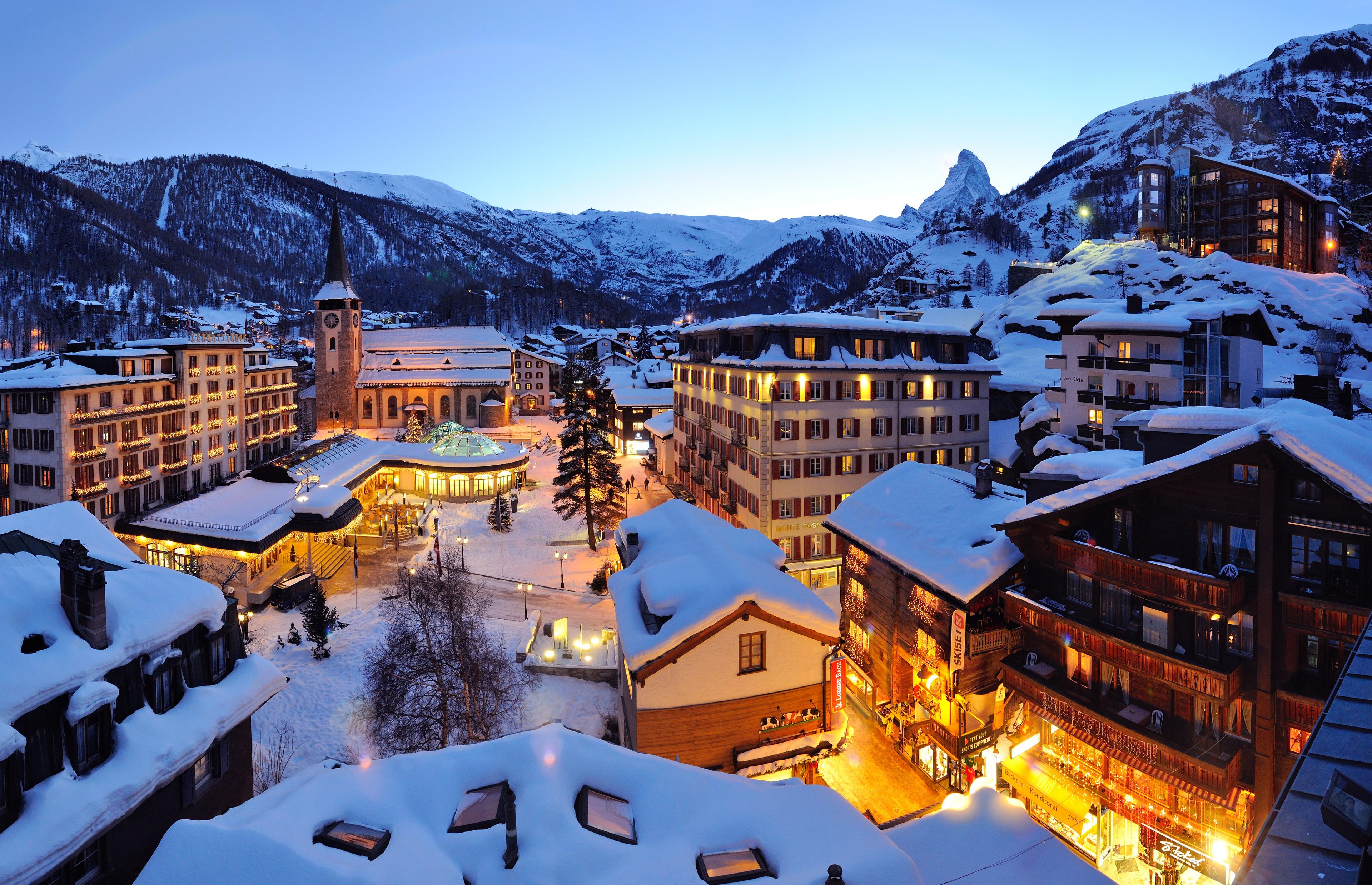
Switzerland offers some of the most spectacular skiing in the world: the Matterhorn and the Eiger, car-free villages, high glaciers and a rail network that can take you from the airport to the slopes. It is the priciest ski country in Europe, but for scenery, snow and sheer quality it is hard to beat.
Few ski countries can match Switzerland's mountains. The Matterhorn above Zermatt, the Eiger, Mönch and Jungfrau above Wengen and Grindelwald, and the glaciers of the Valais make for some of the most memorable views you will ever ski beneath.
Swiss resorts are also among the highest in the Alps. Zermatt's lifts climb to 3,883 m, the highest lift-served skiing in Europe, and its glacier runs stay open almost year-round. Saas-Fee, Verbier and the Engadin around St Moritz also offer high, snow-sure terrain. Many resorts are real towns and villages with long histories, and several, including Zermatt, Saas-Fee, Wengen and Mürren, are car-free, reached only by train, cable car or electric taxi.
Getting around is a pleasure. Trains run from Geneva and Zurich airports into the mountains with famous punctuality, so a car-free ski holiday is easier in Switzerland than almost anywhere else.
Who skiing in Switzerland suits
Skiers who prioritise scenery and atmosphere, from Zermatt's Matterhorn views to the classic villages of the Jungfrau region.
Advanced and off-piste skiers, particularly in Verbier, Zermatt, Engelberg and Andermatt.
Intermediates, who will find long, well-groomed runs in the 4 Vallées, Davos-Klosters, Laax and the Matterhorn ski area.
Travellers who prefer the train, thanks to excellent rail links from the airports and from the UK via Paris.
The big drawback is cost. Lift passes, accommodation and especially eating out are more expensive than in France or Austria, so budget carefully or look at a package.
Ski regions in Switzerland
Switzerland's ski resorts are spread across the Alps, from the French-speaking west to the German- and Romansh-speaking east.
Valais
The biggest and highest ski region, in the south-west near Geneva. It includes Zermatt, whose ski area links with Cervinia and Valtournenche in Italy; car-free Saas-Fee with its glacier; Verbier, the heart of the 4 Vallées and famous for off-piste; and Crans-Montana, with sunny slopes above the Rhône valley. Swiss resorts in the Portes du Soleil, such as Champéry and Morgins, link with Avoriaz and Morzine in France.
Bernese Oberland
Home to the Jungfrau region, where Grindelwald, Wengen and Mürren sit beneath the Eiger, Mönch and Jungfrau. Wengen hosts the Lauberhorn World Cup downhill, the longest on the circuit. Nearby Gstaad and Adelboden are known for traditional chalets and a more exclusive feel.
Graubünden
Switzerland's largest canton, in the east. St Moritz is the glamorous, historic home of winter tourism; Davos and Klosters share a large ski area; Laax, linked with Flims and Falera, is a leading freestyle resort; and Arosa Lenzerheide offers easy-going, family-friendly skiing.
Central Switzerland
Closest to Zurich and Lucerne. Engelberg, beneath Mount Titlis, is known for long off-piste descents, while Andermatt has grown into a big linked area with Sedrun and Disentis.
Choosing a ski resort in Switzerland
Swiss resorts range from huge, international destinations to quiet mountain villages. These questions will help you choose.
How good a skier are you?
Advanced skiers and freeriders should look at Verbier, Engelberg, Andermatt and Zermatt. Intermediates have plenty of choice, including Zermatt, Davos-Klosters, Laax and the Jungfrau region. Beginners are well served by gentle areas in Arosa Lenzerheide, Grindelwald and Saas-Fee, but Swiss lift passes are expensive for a first trip, so check whether a beginner-area pass is available.
How important is snow reliability?
For the most reliable snow, choose a high resort or one with a glacier: Zermatt, Saas-Fee, Verbier's higher slopes, or St Moritz in the Engadin. Lower Bernese Oberland villages are beautiful but can depend more on the weather early and late in the season.
Do you want a car-free resort?
Zermatt, Saas-Fee, Wengen and Mürren are car-free, which makes for quiet, pedestrian-friendly villages. You arrive by train or cable car, so travel light or use luggage services.
What is your budget?
Switzerland is expensive overall, with St Moritz, Gstaad, Verbier and Zermatt at the top end. To keep costs down, travel outside peak weeks, consider self-catering, buy lift passes online in advance, and look for package deals that bundle flights, transfers and accommodation.
Skill level: IntermediateBest for Families, Intermediates, Couples
Explore the slopes, discover where to stay and plan your next mountain escape.
211 km
Ski pistes
2,394 m
Top altitude
Intermediate
Skiing
Explore resort stays
Booking link coming soon
Compare ski resorts in Switzerland
Compare the Swiss resorts we cover side by side, from ski area size and top altitude to who each resort suits and indicative holiday prices. Several Swiss resorts link to larger areas, including across the border into Italy and France, so check what your lift pass covers.
Ski resorts in Switzerland compared by pistes, altitude, ability and season
IntermediateBest for Families, Intermediates, Couples
Nov - Apr
Holidays are offered by our booking partners; check the partner site for current availability.
Plan your trip
Travel information for Switzerland
Ski season
Early December – mid April (Zermatt and Saas-Fee glaciers much longer)
Flight time from the UK
About 1h 30m – 1h 45m to Geneva or Zurich
Main ski airports
Geneva, Zurich, Basel
Typical transfers
1h 30m – 4 hours, often by train
By train
Direct trains from Geneva and Zurich airports into the mountains; Eurostar to Paris then TGV Lyria
Currency
Swiss franc (CHF)
Language
German, French, Italian and Romansh (English widely spoken)
Time difference
UK +1 hour
Getting there
Switzerland is easy to reach from the UK by air or by rail.
By air
Geneva is the main gateway for the Valais, the Portes du Soleil and the Vaud Alps, and Zurich for Graubünden, central Switzerland and much of the Bernese Oberland. Basel is another option. Flights from the UK take around 1 hour 30 minutes to 1 hour 45 minutes. Transfers vary widely, from about 1 hour 30 minutes to Champéry or Engelberg to around 3½ to 4 hours to Zermatt or St Moritz.
By train from the airport
Both Geneva and Zurich airports have their own railway stations, with frequent trains into the Alps. Rail is often the easiest way to reach car-free resorts such as Zermatt, Wengen and Saas-Fee (the last by train and bus). SBB, the Swiss national railway, sells point-to-point tickets and passes covering trains, buses and many mountain railways.
By train from the UK
Take the Eurostar from London to Paris, then a TGV Lyria to Geneva, Lausanne, Basel or Zurich, and connect onto Swiss trains for the mountains. The journey to many resorts takes a long day, but it is relaxed and scenic.
By car
To use Swiss motorways you need a vignette, which costs CHF 40 a year and is available as a digital e-vignette. Carry snow chains in winter, and remember that some resorts can only be reached by train: drivers for Zermatt park at Täsch and take the shuttle train.
When to go
The Swiss ski season usually runs from early or mid-December to mid April. High and glacier resorts such as Zermatt and Saas-Fee open earlier and close later, and Zermatt offers some glacier skiing throughout the year.
Month by month
December: Festive and atmospheric, but choose a high resort before Christmas. Christmas and New Year are very busy and expensive.
January: Cold, quiet and often good value, with crisp snow and fewer people after the first week.
February: Good snow but busy, with Swiss sports holidays staggered by canton from late January to March and UK half-term in mid February.
March: Longer, sunnier days with generally excellent snow at altitude. Many regulars' favourite month.
April: Spring snow and quieter slopes in the high resorts. Lower resorts close after Easter, which falls on 28 March in 2027.
Practical information
Lift passes
Swiss lift passes are among the most expensive in Europe, and several resorts now use dynamic pricing, where the price depends on the date and how early you buy. For 2026/27, Zermatt lists a six-day flex pass for the Swiss side from CHF 510, with a higher price if you include the Italian side. Buying online and in advance is usually cheaper.
Insurance and healthcare
UK nationals can use a UK GHIC for medically necessary state healthcare in Switzerland, but treatment is not free in the same way as on the NHS, and the card does not cover mountain rescue, helicopter evacuation or repatriation. Buy travel insurance that includes winter sports and check the cover for off-piste skiing.
Money and language
Switzerland uses the Swiss franc (CHF), not the euro. Many businesses accept euros, but change is usually given in francs at a poor rate, so pay by card or carry francs. The language depends on the region: French in the west, German in the north and centre, Italian in Ticino and Romansh in parts of Graubünden. English is widely spoken in ski resorts.
On the slopes
Swiss pistes are graded blue (easiest), red and black (hardest). Marked freeride routes are not groomed or patrolled and should be treated as off-piste. Helmets are not compulsory but are strongly recommended. Avalanche danger can be high in the big freeride areas, so ski off-piste only with the right equipment and a qualified guide.
Ski resorts in Switzerland: FAQs
What is the best ski resort in Switzerland?
+
It depends on what you want. Zermatt is the top all-rounder for scenery and snow-sure skiing, Verbier is best for experts and off-piste, Laax is best for freestyle and the Jungfrau region resorts such as Wengen and Grindelwald are best for classic views and traditional villages.
When is the ski season in Switzerland?
+
Most Swiss resorts open in early or mid-December and close in mid April. High-altitude and glacier resorts such as Zermatt and Saas-Fee open earlier and close later, and Zermatt has glacier skiing almost all year.
What is the highest ski resort in Switzerland?
+
Zermatt has the highest lift-served skiing in Switzerland and in the Alps, with lifts reaching 3,883 m on the Klein Matterhorn. Saas-Fee is also very high, with glacier skiing at around 3,500 m.
Is skiing in Switzerland expensive?
+
Yes, Switzerland is usually the most expensive ski destination in Europe. Lift passes, accommodation and eating out cost more than in France or Austria. You can save by buying lift passes in advance, travelling outside peak weeks, self-catering or booking a package.
How do you get to Swiss ski resorts from the UK?
+
Most skiers fly to Geneva or Zurich, which takes about 1½ hours, then continue by train or road. Both airports have their own stations with trains into the mountains. You can also travel by rail all the way, using Eurostar to Paris and a TGV Lyria to Switzerland.
Can I use euros in Swiss ski resorts?
+
Many shops, restaurants and lift companies accept euros, but prices are set in Swiss francs (CHF) and change is usually given in francs at a less favourable rate. Paying by card is the easiest option.
Do you need a helmet to ski in Switzerland?
+
No, helmets are not compulsory in Switzerland, but they are strongly recommended and most skiers and snowboarders wear one. Ski schools generally expect children to wear a helmet.