00Why real snow makes a difference
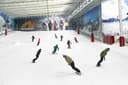
If you've only ever skied on a dry slope, your first run on indoor real snow will feel immediately different. The surface behaves like actual piste snow — it compresses underfoot, responds to edge pressure properly, and is considerably more forgiving when you fall. That last point matters more than beginners expect.
Dry slope matting (usually Dendix or SnowFlex) creates friction in a way that can catch an edge unexpectedly and send you down harder than snow would. Real snow absorbs impact. For this reason, many ski instructors recommend that complete beginners take their first lessons at an indoor real-snow centre if one is accessible — the early confidence gained on a genuine surface pays dividends later.
There's also the psychological element. Skiing real snow indoors, at -4°C, with lifts running and proper piste markers — it genuinely feels like preparation for a resort. A dry slope session is training. A real snow session is a rehearsal.
💡 Quick tip: All five UK real-snow centres offer equipment hire as standard. You don't need to own anything to visit — just bring warm base layers and you're covered.
05The Snow Centre, Hemel Hempstead
The Snow Centre is the benchmark for UK indoor skiing. Situated in Hemel Hempstead, 35 minutes from central London, it draws skiers from across the south-east and has developed a reputation for genuinely excellent instruction. The 160-metre main slope is maintained at -4°C year-round, and the dedicated nursery area with a magic carpet lift keeps beginners well separated from faster traffic.
What sets The Snow Centre apart is the quality of its ski school. Instructors here are BASI-qualified and notably patient with nervous first-timers — the centre has clearly invested in its teaching programme rather than treating lessons as an afterthought. Group lessons for adults run most mornings and evenings, and the beginner packages (slope session plus lesson) represent solid value compared to booking separately.
The facility itself is well-run: lockers, a decent café, a ski and snowboard shop, and free parking. It's not the biggest slope in the UK, but it punches well above its size in terms of the overall experience.
Getting there: The Snow Centre sits just off the A41, 5 minutes from Hemel Hempstead train station. The M25 J20 is a 10-minute drive. Free parking on-site.
10Chill Factore, Manchester
Chill Factore is the UK's longest indoor real-snow ski slope at 180 metres, and comfortably the best option for anyone based in the north of England. Located at the Trafford Centre in Manchester, it benefits from excellent transport links and a broad range of sessions — from early-morning club training slots to late-night freestyle sessions with jump features.
The scale here is genuinely impressive. Beyond the main slope, there's a dedicated beginners' area, a snow park with rails and a kicker for freestyle progression, and a separate snow play zone for young children. If you're bringing a mixed group — some complete beginners, some with intermediate experience — Chill Factore handles that split better than any other UK centre.
The Après ski bar is a nice touch and genuinely busy on weekend evenings. It's become something of a social destination in its own right, which has helped it build a loyal local following well beyond the skiing community.
Getting there: Adjacent to the Trafford Centre — postcode M17 8AS. Well served by Metrolink (Trafford Centre stop) and the A57. Parking at the Trafford Centre (charges apply).
15Snozone Milton Keynes
Snozone's Milton Keynes site sits just off the M1 at Junction 14, making it the most accessible real-snow centre from the East Midlands and a reasonable option for those coming up from north London. The 170-metre main slope is marginally longer than The Snow Centre's, with a well-designed beginner zone and a freestyle area that sees regular use by the local snowboard community.
The standout offering at Snozone MK is the structured Learn to Ski programme — a five-session course that takes a complete beginner from magic carpet to skiing the full main slope independently. If you're planning a ski holiday in the next six months and want to arrive with a genuine foundation, this is the most methodical route available at any UK indoor slope.
Weekday sessions are notably quieter here than at Chill Factore or The Snow Centre, which makes it a better choice if you want space to practise without weekend crowds.
19Snozone Castleford
The newer of the two Snozone sites, Castleford opened with a slightly more compact slope (140 metres) but benefits from the same operational standards as its Milton Keynes sibling. It fills an important gap in the north-east market — previously, anyone outside Manchester had to drive a significant distance for real-snow indoor skiing.
The beginner programme is identical to Milton Keynes, and the instruction quality is consistent. For intermediate and advanced skiers, the slope is on the shorter side, but the freestyle area is well-maintained and the resort has invested in varied terrain features.
22What to expect on your first visit
First-time visitors to any UK indoor snow centre are often surprised by how cold it genuinely is. -4°C sounds manageable — and it is, once you're moving — but standing at the top of the slope waiting for a lesson to start will remind you that this is a genuine cold environment, not a climate-controlled room with a chill.
Wear a proper base layer (merino or synthetic — not cotton), a mid layer, and gloves. Helmets are mandatory at all UK indoor centres and are included in hire packages. Goggles are worth bringing if you have them, though not strictly necessary on a short indoor slope.
Budget around 2–3 hours for a first visit if you're doing a lesson plus free practice. Most centres stagger their lesson start times, so you won't need to queue.
📋 What to bring: Base layer, mid layer, thick socks, gloves. Everything else (boots, skis/board, helmet) is included in hire. Leave the ski jacket for your actual holiday — the centres provide warm enough conditions without it.
27Real snow vs dry slope — is it worth the extra cost?
Real-snow sessions typically cost £8–15 more than an equivalent dry slope session. Whether that's worth it depends on what you're trying to achieve.
For complete beginners, real snow is worth every penny. The learning curve is gentler, falls are softer, and the experience gives a more accurate preview of what resort skiing will feel like. If you're investing in lessons ahead of an Alps trip, do them on real snow.
For intermediate skiers maintaining fitness and technique between seasons, a dry slope season ticket often makes more economic sense — sessions are cheaper, the slopes are often closer, and the technique transfer is good enough for most drills. Many committed club skiers train on dry slope through the autumn and only head to a real-snow centre for a pre-season shakedown in November.
The two formats complement each other rather than compete. Think of dry slope as the gym and real snow as the match.